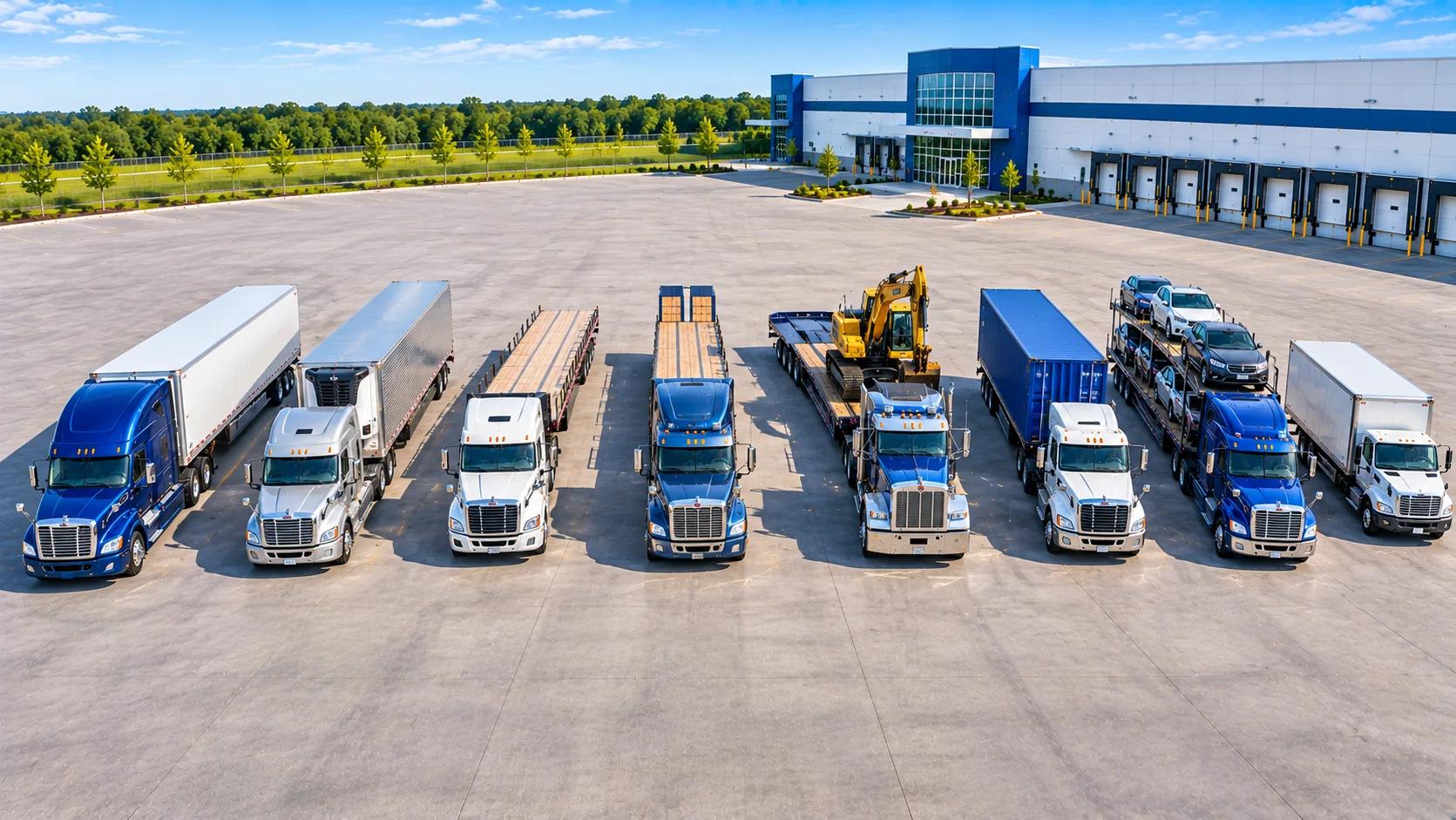
Equipment Guide
Equipment & Trailer Specifications
Planning figures for the trailers and containers shippers book most often. Use them to check pallet counts, freight height and payload before you tender a load.
| Equipment | Length | Width | Height / freight height | Deck height | Max payload | Capacity | Best for |
|---|---|---|---|---|---|---|---|
| Dry Van 53' | 52' 6" interior | 8' 2"–8' 4" interior | 8' 10"–9' 0" interior | ~4' 0" | 42,000–45,000 lbs | 26 pallets (52 double-stacked) | Palletized and boxed consumer, retail and industrial goods |
| Refrigerated (Reefer) 53' | ~51' 6" interior | ~8' 2" interior | ~8' 6" interior | ~4' 2" | 42,000–44,000 lbs | 26–30 pallets, -20°F to +70°F | Fresh and frozen food, beverages, pharmaceuticals |
| Flatbed 48' | 48' deck | 8' 6" | 8' 6" legal freight height | ~5' 0" | 46,000–48,000 lbs | Open deck, side and top loading | Steel, lumber, pipe, building materials |
| Flatbed 53' | 53' deck | 8' 6" | 8' 6" legal freight height | ~5' 0" | 45,000–47,000 lbs | Open deck for long material | Trusses, beams, long steel and lumber |
| Step Deck (Drop Deck) | 48'–53' (lower deck 37'–43') | 8' 6" | ~10' 0" on lower deck | ~3' 6" lower / ~5' 0" upper | 45,000–48,000 lbs | Two-level deck, ramps available | Tall machinery, tractors, crated equipment |
| RGN / Lowboy | 24'–29' well (3-axle) | 8' 6" (wider with permits) | ~11' 6" legal freight height | 18"–24" well | ~40,000–42,000 lbs standard; 150,000+ lbs multi-axle | Drive-on loading via detachable neck | Excavators, dozers, cranes, oversize machinery |
| Container 20' | 19' 4" interior | 7' 8" interior | 7' 10" interior | ~4' 6" on chassis | Up to ~47,000 lbs cargo (road limits apply) | ~33 m³, 10 standard pallets | Dense import freight: tile, stone, metals, paper |
| Container 40' / 40' HC | 39' 6" interior | 7' 8" interior | 7' 10" (8' 10" high cube) | ~4' 6" on chassis | ~44,000–58,000 lbs gross rating (road limits apply) | ~67–76 m³, 20–21 standard pallets | General import and export cargo |
Typical figures for planning. Actual dimensions and legal payload vary by trailer manufacturer, axle configuration, tractor weight and state law.
Planning rules
Four limits that decide the trailer
Legal height and width
Most states cap overall height at 13' 6" (some western states allow 14' or more) and width at 8' 6". Subtract the deck height from the height limit to find how tall your freight can be without a permit.
Gross and axle weight
Federal limits are 80,000 lbs gross, 20,000 lbs on a single axle and 34,000 lbs on a tandem. Tractor and trailer weigh roughly 30,000–35,000 lbs, which sets the practical payload.
Pallet math
A standard 48" × 40" pallet uses one position. A 53' trailer holds 26 positions in two rows, 13 deep. Turned or oversized pallets reduce the count.
Bridge formula
Weight must be spread over enough distance between axles. Heavy, concentrated loads may need a different axle spacing or more axles even below 80,000 lbs.
By equipment
Which trailer fits your freight?
Dry Van 53'
Palletized and boxed consumer, retail and industrial goods
42,000–45,000 lbs
Refrigerated (Reefer) 53'
Fresh and frozen food, beverages, pharmaceuticals
42,000–44,000 lbs
Flatbed 48'
Steel, lumber, pipe, building materials
46,000–48,000 lbs
Flatbed 53'
Trusses, beams, long steel and lumber
45,000–47,000 lbs
Step Deck (Drop Deck)
Tall machinery, tractors, crated equipment
45,000–48,000 lbs
RGN / Lowboy
Excavators, dozers, cranes, oversize machinery
~40,000–42,000 lbs standard; 150,000+ lbs multi-axle
Container 20'
Dense import freight: tile, stone, metals, paper
Up to ~47,000 lbs cargo (road limits apply)
Container 40' / 40' HC
General import and export cargo
~44,000–58,000 lbs gross rating (road limits apply)
Planning guide
Using these figures to plan a load.
How to read trailer specifications, plan pallet counts and stay within legal weight before you tender freight.
Reading trailer specifications correctly
Published trailer dimensions are a starting point, not a guarantee. Interior width on a dry van is usually around 98 to 101 inches, but door openings are narrower and logistics posts or scuff liners can reduce usable space. Interior height depends on the trailer's floor thickness and roof design. A load that measures to the inch against a brochure figure may not fit the trailer that actually arrives. When freight is close to a limit, tell us the measurement and we will confirm the specific equipment before dispatch.
Weight is the more common constraint. A standard five-axle tractor-trailer is limited to 80,000 pounds gross vehicle weight on interstate highways, with axle limits of 12,000 pounds on the steer axle and 34,000 pounds on each tandem. The weight left for freight depends on the empty weight of the specific tractor and trailer. A lightweight van with a fuel-efficient tractor may legally carry 45,000 pounds; a heavier reefer setup may be closer to 42,000 to 43,000 pounds.
Pallet counts and floor planning
A 53-foot trailer holds 26 standard 48 by 40 inch pallets loaded straight in two rows, or up to 30 when loaded in a pinwheel or turned pattern, depending on pallet size and how the freight overhangs. Double stacking can double that count when the freight is stackable and the combined height clears the door, but stacking also raises the center of gravity and the risk of load shift.
- Measure the largest pallet footprint including any overhang
- Confirm whether the freight can be stacked and to what height
- Note any freight that must be loaded last or delivered first
- Share the total weight and the heaviest single piece
With those four facts, our desk can tell you how many trailers you need, whether a partial load makes sense and where weight should sit to stay within axle limits.
Open deck and specialized equipment
Flatbeds commonly run 48 or 53 feet with a deck height of about 5 feet, which leaves roughly 8 feet 6 inches of legal freight height. Step decks drop the rear deck to about 3 feet 6 inches, allowing freight up to about 10 feet tall without a height permit. Removable gooseneck lowboys go lower still, typically 18 to 24 inches, so tall machinery can travel within or close to legal height.
Securement requirements vary with the freight. Steel coils, lumber, machinery and pipe each have specific rules for the number of tie-downs, edge protection and blocking. Carriers hauling open deck freight for us must supply the straps, chains, binders and tarps the load requires, and those requirements are written into the rate confirmation.
Containers and intermodal equipment
Ocean containers come in 20-foot, 40-foot and 40-foot high cube sizes, with domestic intermodal containers running 53 feet. Container weight limits depend on the chassis, the number of axles and the state, and an overweight container may need a tri-axle chassis or a permit. Port drayage also brings terminal appointment systems and free time limits, both of which affect the plan as much as the equipment does.
If you are unsure which equipment fits a shipment, send the commodity, dimensions and weight. A freight specialist will recommend the trailer and explain the reason, so the choice is clear before you book.
Common planning mistakes to avoid
Most equipment problems at pickup come from a handful of avoidable mistakes. Checking these before you request a quote saves time and extra charges.
- Quoting gross weight without pallets and packaging, which can add 1,500 pounds or more to a full load
- Measuring freight height without the pallet, or forgetting a crate lid or lifting lugs
- Assuming a dock is available when the receiver only has ground-level access
- Booking a 53-foot trailer for a location that only accepts 48-foot equipment
- Loading heavy freight at the rear of the trailer, which overloads the trailer tandem
If the freight or the location is unusual, a photo of the freight and the loading area is often the quickest way for us to recommend the right equipment.
Asking for an equipment recommendation
Our freight desk answers equipment questions every day, whether or not a load is ready to book. Send the commodity, the weight, the dimensions of the largest piece, how it will be loaded and unloaded, and the pickup and delivery locations. We will recommend the equipment, explain any permit or handling requirements and give a planning estimate so your team can budget with confidence.
Not sure which equipment you need?
Send the dimensions and weight. We will recommend the trailer that moves it legally at the lowest cost.