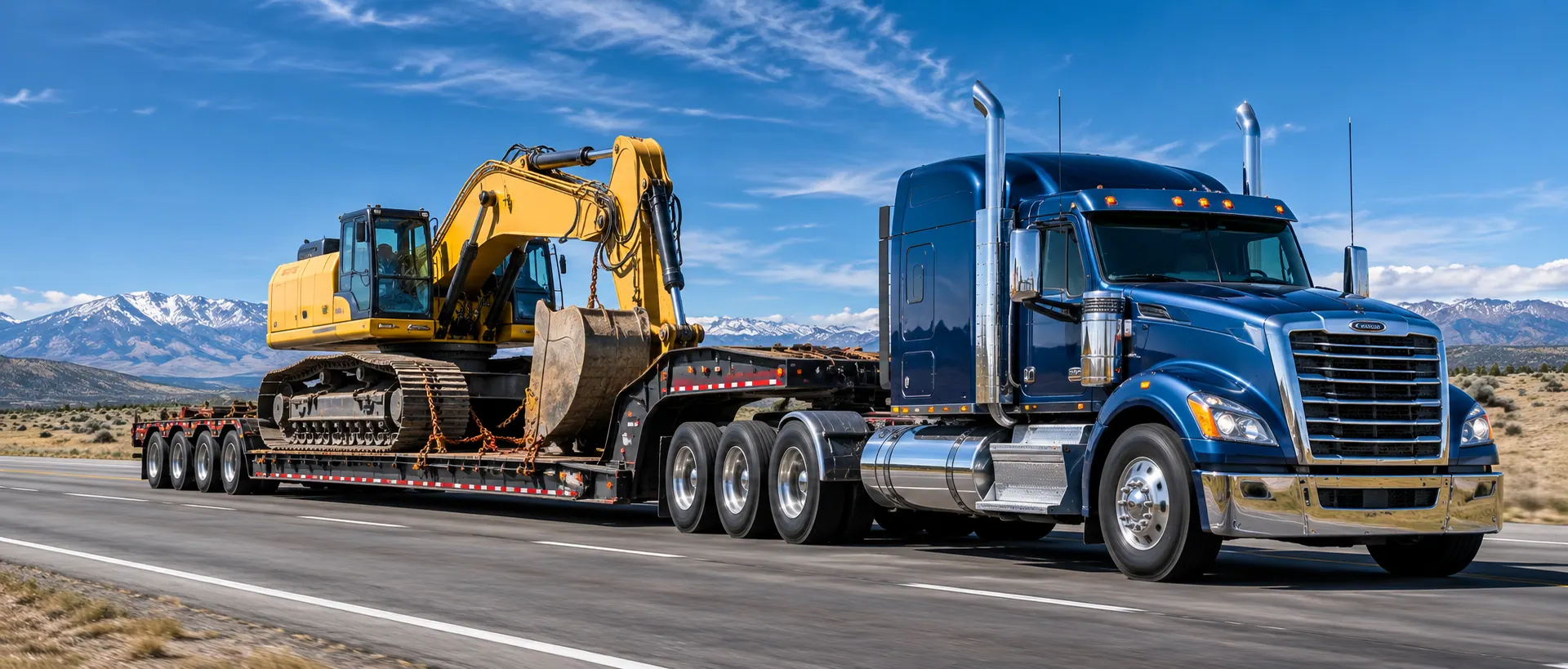
Heavy haul is a planning job first
The trailer is the visible part of a heavy haul move, but most of the work happens before the truck arrives. Every state sets its own limits for width, height, length and weight, its own permit process, its own escort rules and its own travel restrictions on weekends, holidays and at night. A load that crosses four states needs four permits that agree with each other on route, dimensions and dates.
Our heavy haul desk collects exact machine specifications, confirms how the equipment will be loaded and secured, selects the trailer that keeps the load as low and light as possible, and then applies for permits on a route that the equipment can actually travel. When the dimensions call for it, we order route surveys, pilot cars, police escorts and utility crews to lift lines.
Removable gooseneck (RGN) trailers
A removable gooseneck trailer detaches at the front so the deck lowers to the ground and forms a ramp. Tracked and wheeled machinery can drive straight on without a crane or loading dock. Once the neck is reattached, the well of the trailer sits only about 18 to 24 inches off the road, which leaves room for tall equipment to stay under height limits.
RGNs are the standard choice for excavators, dozers, loaders, motor graders, cranes, tractors and combines. They come in 2-axle through 3-axle standard configurations, with additional axles, jeeps and boosters added to spread weight on heavier loads. Hydraulic RGNs detach with the tractor's wet kit; mechanical versions use a manual process and are lighter.
Lowboys, double drops and multi-axle configurations
Fixed-neck lowboys and double drop trailers serve loads that are lifted on by crane, such as transformers, tanks, vessels and industrial presses. For the heaviest freight, carriers build multi-axle combinations with jeeps (axles ahead of the trailer), stingers and boosters (axles behind it), and in some cases perimeter or beam trailers that cradle the load between two rails.
Adding axles lets the load meet per-axle limits on state roads, which can turn a move that would otherwise need a superload permit into a standard overweight permit. The trade-off is higher equipment cost, so we model a few configurations and show you the price and permit implications of each.
Permits, escorts and route surveys
Permit thresholds vary, but loads wider than 8' 6", taller than about 13' 6" to 14' 6" depending on the state, or heavier than 80,000 lbs gross need oversize or overweight permits. Wider loads typically need one or two escort vehicles, flags and banners, and may be limited to daylight travel. Very large moves, often called superloads, can require engineering review of bridges and weeks of lead time.
- Permit applications in each state on the route, with dates and dimensions that match
- Certified pilot car escorts placed front, rear or both as each state requires
- Route surveys to measure overhead clearances, turning radii and road conditions
- Utility and traffic signal coordination where clearances are tight
- Police escorts where a state or city mandates them
Lead time depends on the size of the load. Standard oversize permits are often issued within a day or two. Superloads may need two to six weeks. The earlier we receive accurate dimensions, the more route options we have.
Equipment we move
Our heavy haul shipments span construction, agriculture, mining, energy and industrial manufacturing:
- Excavators, dozers, wheel loaders, skid steers, compactors and motor graders
- Combines, tractors, sprayers, planters and grain handling equipment
- Mining haul truck components, crushers and screening plants
- Generators, transformers, compressors and switchgear
- CNC machines, presses, industrial ovens and production line modules
- Boats, yachts on cradles, and modular building sections
Preparing your machine for transport
Accurate dimensions are the single most important thing a shipper provides. Measure the machine in its transport position, with buckets curled, booms lowered and attachments removed where practical. Share the operating weight, plus the weight of any attachments shipping with it. Note the tie-down points, whether the machine runs, and who will load and unload it.
On pickup, the driver photographs the equipment, chains it at the manufacturer's tie-down points with chain and binders rated for the load, and covers exhaust stacks and loose components. We confirm the receiver can offload the machine or arrange for it to be driven off on arrival.
Pricing a heavy haul move
Heavy haul quotes include several parts beyond the line-haul rate. Permit fees vary by state and by the size and weight of the load. Escort vehicles are billed per mile or per day. Route surveys, utility line lifts and police escorts carry their own costs. Specialized trailers with extra axles cost more to operate than a standard RGN. Travel restrictions can also extend the trip, since many states allow oversize loads to move only in daylight and not on weekends or holidays.
We present these costs line by line so you can see what drives the total and compare options, such as removing an attachment to lower the height or width enough to avoid an escort.