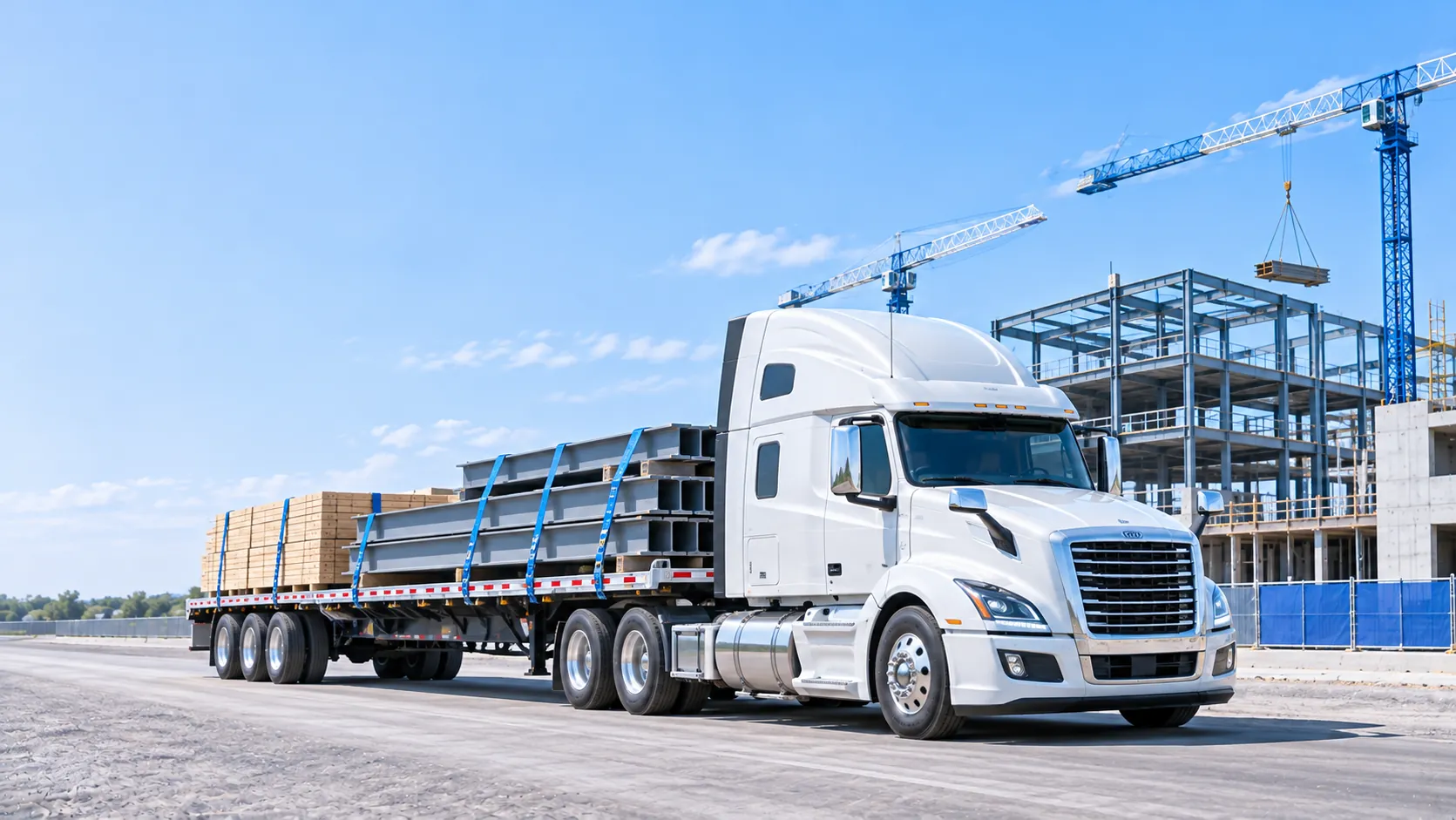
Industries · Construction & Heavy Equipment
Equipment and material to the job site, on the day it is needed.
Construction freight rarely goes dock to dock. It goes to a muddy site with a gate, a foreman and a crane booked for one morning. We plan for the site as carefully as for the road.
What we handle
Machines to job sites, material to yards and equipment between projects, with permits and site access handled before the truck rolls.
- Excavators, dozers and cranes on RGN and lowboy
- Steel, rebar, lumber and precast on flatbeds
- Job-site deliveries with crane or forklift timing
- Oversize permits, escorts and route surveys
Pressure points
What makes construction & heavy equipment freight different.
Oversize and overweight
Machines often exceed legal width, height or weight. Permits, escorts and route surveys have to be in place before pickup.
Site access
Soft ground, tight turns, low wires and limited unloading space all affect which trailer can actually deliver.
Crane and crew timing
A late truck can leave a crew and crane standing. Delivery windows on job sites are as strict as any retail dock.
Securement
Steel, rebar, lumber and precast each have their own securement rules. Mistakes are dangerous and expensive.
How we work
Our construction & heavy equipment freight program.
Moving equipment between yards and job sites
Excavators, dozers, loaders, cranes and other heavy machines move on RGN, lowboy and step deck trailers. The right trailer depends on the machine's weight, height and footprint, and on whether it can be driven on or must be lifted. Before we quote, we ask for the make and model, the operating weight, the transport dimensions with any attachments, and whether the bucket, boom or tracks will be removed.
When a load is over legal dimensions, our specialized desk orders the state permits along the route, books escorts where they are required and checks for bridge, height and travel-time restrictions. Some states only allow oversize travel in daylight hours or on weekdays, so permit timing affects the delivery date. We tell you that up front rather than letting it surprise you on the road.
Building materials on flatbeds
Structural steel, rebar, lumber, trusses, precast concrete and pipe are the backbone of open-deck freight. Each needs the right trailer, the right number of tie-downs and sometimes tarps, edge protection or dunnage. We write those requirements onto the rate confirmation so the carrier arrives prepared, and we use carriers whose drivers handle that commodity regularly.
Many job sites receive material in a sequence: footings first, then steel, then decking and so on. We can schedule a series of loads to match the build sequence and adjust the plan when the site falls behind or jumps ahead.
Planning for the site, not just the road
The hardest part of a construction delivery is often the last hundred yards. Before dispatch we confirm the site address and gate, who will meet the driver, how the load will be unloaded, whether the ground will carry the truck and whether there is room to turn around. If a crane or forklift is coming, we coordinate the truck's arrival with that booking.
Drivers are given a site contact and a phone number for the superintendent. If the site is not ready when the truck arrives, we work out the cheapest option with you on the spot, whether that is waiting, staging nearby or rescheduling.
Project freight and emergencies
Large projects can involve hundreds of loads from many suppliers. We can act as the single coordination point, tracking every inbound load against the site schedule and flagging conflicts before they cause a backlog at the gate. And when a machine breaks down and a replacement part or rental unit has to arrive tomorrow, our dispatch desk is available around the clock to cover it.
How we choose carriers for heavy and open-deck freight
Open-deck and heavy haul carriers are checked for authority, insurance limits that suit the value of the machine, and safety records. For oversize loads we also confirm the carrier's experience with permitted travel and escorts, and that the driver is comfortable with job-site deliveries. A carrier who has never delivered to an active site is not the one we send to a crane pick at 7 a.m.
Securement is checked against the commodity and the trailer, and any special requirement, from chains on tracked equipment to edge protection on finished steel, is written down before the truck arrives.
Equipment we use most for construction
- RGN and removable gooseneck trailers for tracked and wheeled machines that drive on.
- Multi-axle lowboys for heavier excavators, cranes and dozers beyond standard RGN capacity.
- Step decks for taller loads such as skid steers, lifts and modular components.
- Flatbeds for steel, rebar, lumber, trusses and precast, with tarps when required.
- Hot-shot and expedited trucks for urgent parts and smaller equipment.
Trailer choice affects permits, cost and whether the truck can get into the site at all. We pick it with the site in mind, not just the machine.
Updates from the road and the gate
Construction schedules change daily, so the information we send has to be timely. You get confirmation when the load is secured and rolling, regular updates during oversize travel, and a call before arrival so the site can be ready. If a permit restriction, weather or a road closure changes the plan, we tell you straight away with a revised arrival time and options.
Getting started
For a single machine move, send us the make, model, weight and dimensions with both addresses and your preferred dates. For a project, tell us the site location, the main suppliers and the rough build sequence. We will quote the first moves and propose a coordination plan for the rest. Our 24/7 dispatch desk is available whenever something breaks on site and a replacement has to move fast.
Construction & Heavy Equipment FAQs
Common questions
- What do you need to quote an equipment move?
- Make and model, operating weight, transport length, width and height with attachments, pickup and delivery addresses, and how the machine will be loaded and unloaded.
- Do you arrange oversize permits and escorts?
- Yes. Our specialized desk orders permits for each state on the route, books required escorts and plans around travel restrictions.
- Can you deliver to an active job site?
- Yes. We confirm access, unloading method and the site contact before dispatch, and coordinate arrival with any crane or forklift booking.
- Do you handle tarped loads?
- Yes. Tarp requirements are written on the rate confirmation and the carrier confirms they will bring the right tarps before the load is tendered.
Have freight that needs to move?
Send the lane, the equipment and the date. Our team prices standard truckload lanes within the hour on business days, and the dispatch desk answers around the clock.